Today we have a guest post from my friend Laura Leifield, who is an artist, a writer, and a member of my online writing group, The Coven of Scribblers. She once challenged our group to write a picture essay from a photo she selected, and I remember having a hard time only writing a thousand words. She’s multitalented, and starting a blog as well, so be sure to stop by!
sometimes a writer.
only did for myself, and I never shared my work with anyone. Mostly this was
because I was afraid of what kind of critique my work would receive. It wasn’t
something I ever took courses to learn in college. So, of course I didn’t know anything
about it. Right?
that maybe I could take what I knew of art and painting and apply it to my
writing. Perhaps not the parts about how to properly wash your brushes, or what
kind of oil would work best with the style I was painting in, but the
basic information. Art and writing are not completely
unrelated – they share a family tree in that they are both methods of creative
expression.
use…
tells you where parts will go, it tells you what the piece is about, and if
your drawing is wrong, you’ve got problems. No matter how hard you work on the
details of someone’s eyes, the fact that they’re missing a nose is not going to
escape your audience’s attention.
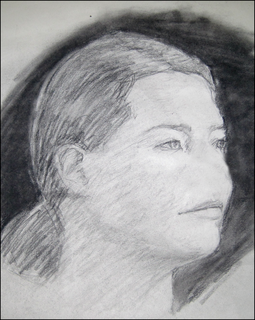
your story. Where you have missing pieces here, you have major problems. Fix
this first, because it isn’t going to go unnoticed.
point. “But that’s just how I like it” becomes an excuse for laziness. They
don’t want to work to get it right, so they say they wanted
their apple to look flat, or their dog to have a neck that stretches far longer
than a dog’s neck should ever stretch, or, or, or…
artist. Sure, there are painters who do that, but the good ones have a decided
method to their madness, an education and knowledge behind it all.
are valid, or if I’m just not yet practiced enough to understand what is style
and what isn’t. I’m getting better at that, I think. Reading a lot helps.
Looking for reason behind other writers’ choices is key – Why that verb? Why
that rhythm?
is.
by four-foot canvas was painted in reverent detail? Crystal clear from the
foreground to the background, sharp edges on everything? Did you have a hard
time figuring out what that painting was about, or what you should even be
looking at?
nearly everything, only to find a few sharp places in the brightest areas – the
center of focus. “Here, look here. This is what I want you to see.”
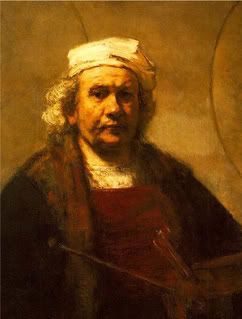
he was wearing…
the inner workings of a clock that hangs on the wall in the protagonist’s
father’s office. Why not? BECAUSE NOBODY CARES. It doesn’t matter how
beautifully you described those shiny gears. The delete key is still your
friend.
paint, okay?
oil paint?” Well, sure. They make every color you could think of. I own a tube
of copper myself. Do I use it to paint metal? No. Why? Because it would look
wrong.
metal, you have to paint correct relationships between the lights and darks.
Show us how the light is reflecting. That’s all. You don’t need to slather
silver all over your canvas. (Look! Look! It’s SILVERRRR!) Yes, that would make
it shiny, but it wouldn’t correctly represent your grandmother’s prized jewelry
box.
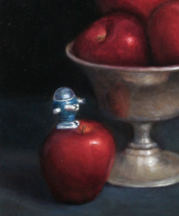
say that Henry is an angry young child, but it holds much
more punch when we show this through his actions and dialogue. In what happens
in the story.
reading, by listening to others’ insight, and by doing it every day. But
sometimes I feel lucky that I have painting to help me relate – it’s a great
lens to study this subject through.
would make excellent painters, too.
Well, I’m certain I will never be able to move beyond the hangman stage, much less produce the kind of amazing fine art that Laura does (I love the whimsy of the robot, Laura!). Laura has been critiquing my stories for a long time, and I always find her insights fantastic. She has an almost poetic command of language, and believe me when I say her writing is as fine as her art. Laura, thanks for sharing with us today!
AND NOW …
The winner (by random drawing) of Amazing Faces is: Rose Deniz!
A BIG THANKS to everyone who has participated in Art Appreciation Week!
Facinating Post! I love it when the arts intertwine and I love learning about the crafting of something foriegn to me. Thank you for sharing.
Laura is my favorite. You're right, her writing AND her art are fantastic. I'm waiting for the day I can hold a published book of hers in my hand 🙂
Great post! Love, love loved this:
"Same goes for writing. We don’t need three paragraphs about the inner workings of a clock that hangs on the wall in the protagonist’s father’s office. Why not? BECAUSE NOBODY CARES."
Ha, so true. Awesome!
Reading a lot DOES help a writer. But art…I think it takes a lot more than what I have to be a visual artist. (Money, for one thing. It costs a lot to buy paints and supplies! But that isn't the major reason. lol)
But it's true that both writing and art require knowledge and a keen eye for detail. You can't leave the nose off the face!
Excellent post. Thank you, Susan. I'm really hoping that my revisions will soon be done and I'll have time to read your book. It's first on the stack of books to read on my shelf!
Ann
@Taryn This week certainly has been an education for me!
@Kaitlyn Me too!
@Steph One of the things I love about Laura is her spot on analysis of things like that! 🙂
@Ann I can't wait to hear what you think of it! Thanks for taking time to stop by this week!
成功多屬於那些很快做出決定,卻又不輕易變更的人。而失敗也經常屬於那些很難做出決定,卻又經常變更的人..................................................... ............
Great post, I really like the correlation of writing and the visual arts.
Thanks so much everyone!
And thanks to you, Sue, for letting me play along with your awesome art week. 😀
-L
Another amazing post, Susan! Thanks so much for hosting Art Appreciation week.
Laura, I really enjoyed your insights. This interview is one I want to reread carefully and consider how it applies to my writing. Thank you.
路過留言支持~~~..................................................
We're a gaggle of volunteers and starting a new scheme in our community. Your website provided us with valuable information to work on. You have done an impressive job and our entire group will be thankful to you.
Also visit my website: http://www.osteopatiacreso.com/wiki/index.php?title=Utente:FLAJeanet
Hurrah, that's what I was searching for, what a stuff! existing here at this webpage, thanks admin of this website.
Feel free to surf to my page :: Chaussures De Foot